Spend time with Corné Eksteen and it quickly becomes clear that painting is only part of his practice. He is endlessly curious about the world around him, whether that means questioning how technology shapes identity, experimenting with colour, revisiting the traditions of portraiture or simply observing life from his studio in rural South Africa.
His paintings often ask us to look more closely. Familiar faces become layered reflections on perception. Repeated patterns challenge the way we consume images. Even the vibrant colours of his recent Optical Bias series have something to say about repetition, consumer culture and the world we live in.
In this conversation, Corné reflects on creativity as a way of life, why he believes great portraits should hold more than one emotion, how technology continues to influence his work, and why he remains optimistic about the future of painting in the age of artificial intelligence.
Above all, it's a reminder that art doesn't need to provide all the answers. Sometimes its greatest role is simply to encourage us to look at the world with fresh eyes.
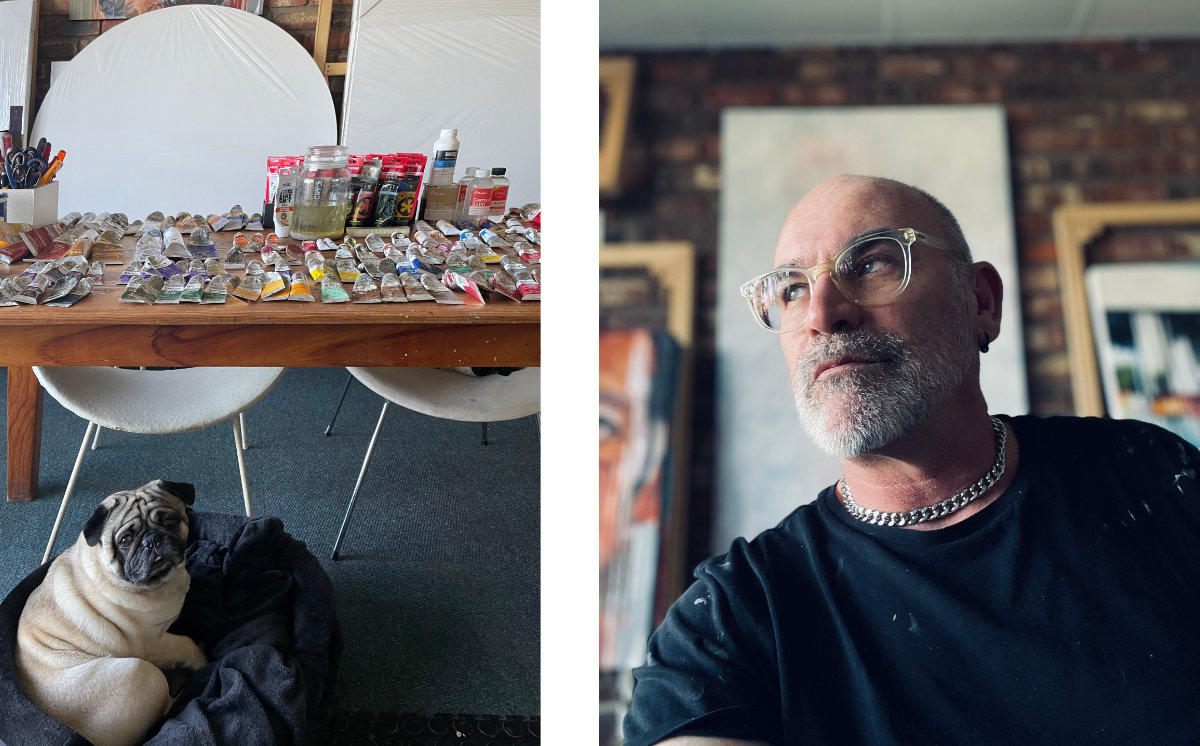
artist Corné Eksteen and his loveable studio companion
You have said “I was born an artist, it’s my default setting, much to the annoyance of many people along the way.” Can you speak more on what you think makes a creative spirit? Why does creativity feel essential to you?
Creativity is a self-perpetuating curiosity, a deep desire to understand, explore and learn. It’s fed by experiences and perceptions and in return it creates new experiences and shifts perceptions. Being curious is a life force and its product is creativity.
There is often a moody, contemplative feeling to your portraiture, we seldom see your subjects smiling. Can you speak about what draws you towards this more thoughtful, and pensive atmosphere in your works?
I always have one foot stuck in academia, especially with portraiture, where I refer to great historic portraiture in my work. I find portraits that are limited to a single emotion, smiling, laughing or crying, quite disturbing. I think that great portraits try to capture more than a single emotion or state of being. They are mysterious and can represent many emotional states in one image. For me a smile or laughing face is something that belongs to photography, family photos and magazine adverts.
Can you speak about your choice to incorporate the vibrant pop art/op art backgrounds in your latest ‘Optical Bias’ series and why you chose their smaller format and various iterations?
I always create work in series, which normally occurred over a long period of time, exploring the same subject and concept through a number of works. Often in retrospect these bodies of work didn’t “read” as a series because they were created over such a long span of time, with other works being created in between and other ideas seeping into the original idea over time. With this series I made the deliberate decision to create the entire series over a short period of time, thus the choice to work in a smaller format. I wanted each of the works to immediately “read” as part of this specific series, to the extent that the entire series could function as a single artwork.
The appearance of vibrant pop / op art elements in my work is something that’s been boiling under the surface for some time. From a purely technical point of view, using flat colour fields in the background creates an interesting contrast with the visually busy execution of the subject matter. Conceptually it comments on the nature of the material world where mass production and standardization are at the center of consumption. It also comments on the zeitgeist of our post-truth society, where, if something is repeated often enough it is considered truth or the norm.
Right now there is a lot of dialogue about the value of human creativity and its perceived decline in the wake of AI. What advice would you give to young creatives who find themselves at a crossroads where they are questioning the validity and feasibility of a creative life?
We live in a bizarre time where new technology is so advanced that if we didn’t know better, we could mistake it for “magic.” But these big jumps in technology are not new. Just over a century ago, all painters were told their careers are over and dead with the arrival of photography. Instead, it triggered some of the most amazing new art movements in the twentieth century. Never think of technology as an obstacle, but rather an inspiration. As for AI specifically, it has not proved its usefulness yet and if it doesn’t it will disappear as quickly as flip-phones and Blackberries in 2009.
Our world feels at a catalytic point as we witness old worlds and ways dying and persevere towards something new. Do you think the role of an artist changes when society is in crisis?
It depends on the artist’s personal perceived role in society. If an artist perceives themselves as the voice of reason in the world, then right now they have their work cut out for themselves. I see myself as the kind of artist that acknowledges problems but doesn’t feel the need to present solutions or take a moral stand against something. I’m more interested in capturing the beauty of the now, created in a language that acknowledges the artistic traditions on which it is built, while providing a personal perspective, presented as a small contribution to the story of humanity.
On the topic of technology, your focus on the negotiation of identity is of course influenced by “algorithms, social media and tons of other white noise interferences” - has the recent rapid increase in tech white noise influenced or changed this perpetual negotiation of the self for you?
I think there’s been a shift in the few years. Where the influence of technology and its associated influences is becoming just that white noise in the background. The influence and presence of technology will never be absent from my work, but the focus is shifting towards the everyday and the personal. Living in rural Africa in the 21st century, with access to all the trappings of technology and consumerism, yet in a setting where I have access to snowcapped mountains, dams, rivers and wildlife on my doorstep. That juxtaposition between the technological and natural is starting to take center stage. In many ways the negotiation of self now has a specific location attached to it, where I’m the artist influenced by algorithms, but also concerned with collecting eggs from my chickens, picking fresh lemons and having morning coffee with a pug on my lap while watching horses play in the pen across the street from my studio.
Your use of colour, be it the effervescent and vibrant colours of Optical Bias to your cloudscapes is always so arresting - what draws you to such nuanced use of colour?
I have a weird relationship with colour. It’s often an internal conflict between toning it down or lashing out in super saturated colours which is often decided by my mood or my own biases in that moment. I’m making a conscious effort to break free of self-imposed limitations relating to colour. For example: a lecturer once said in a painting class that artists move away from saturated colours as they mature. Being told that by a highly regarded artist in a lecture, sticks as an absolute truth and becomes a limitation. Each new painting is a step closer to figuring out where I land in respect to this supposed rule.
Are there any artists or artworks that are providing you with hope and inspiration right now?
I’ve been looking at a lot of op / geometric art recently and have fallen in love with work by artists Claudia Krasberg and Angela Johal. On a more figurative front, I find Conrado López’s work remarkable and inspiring.
Is there a part of your practice that currently brings you joy or makes you feel excited about creating?
I think the most joy and gratitude currently comes from art supplies. We have access to the best and most remarkable art supplies in human history. There’s not a week that goes by that I don’t get to try a new pigment or brush. I’ve recently started working with colours from Gamblin and having the best time with their paint. It still blows my mind that I can have paint made halfway across the world, delivered to my door in rural Africa at the click of a button.
View available work by Corné Eksteen here >